What Are Digital Skills?
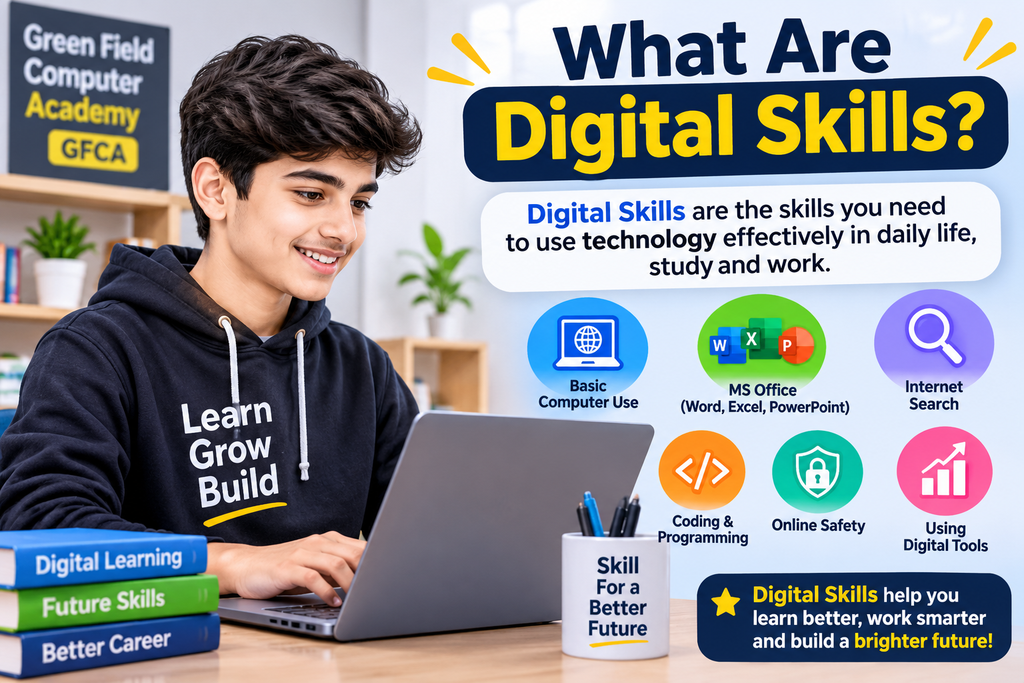
Digital skills are the abilities that help you use computers, mobile phones, the internet, and software. Almost every school, office, shop, and hospital now uses technology. Therefore, digital skills have become a part of daily life.
For example, here are some common types of digital skills:
- Computer basics: typing, using a mouse, and saving files and folders.
- MS Office: using Word, Excel, and PowerPoint.
- Internet skills: searching for correct information and using online platforms.
- Coding: learning languages such as Python, C, and C++.
- Digital communication: sending emails and joining video meetings.
- AI tools: using artificial intelligence to learn and create.
- Online safety: protecting your personal details and avoiding unsafe websites.
As a result, a student with good digital skills feels more confident and independent. Therefore, Green Field Computer Academy teaches these digital skills step by step, so every student can learn at a comfortable speed.
What Is Traditional Education?
Traditional education is learning through teachers, textbooks, classrooms, homework, and exams. First, it teaches subjects such as mathematics, science, English, and social studies. Besides subject knowledge, it also teaches discipline, patience, and teamwork.
For example, mathematics teaches students how to think in a logical way. Similarly, English helps them speak and write clearly. Science, on the other hand, helps them understand how the world works.
Why Digital Skills Matter for Students
Because technology is now part of every career, students need it. Because of this, students who learn digital skills early have a clear advantage. Here are the main reasons.
1. Better Learning Opportunities
Also, digital skills let students learn from videos, online classes, and educational websites. For instance, if a student cannot understand a science topic, they can watch a simple video and learn it again at their own speed.
2. Preparation for Future Careers
Most companies use computers every day. Therefore, students with digital skills can adjust to a job much faster. For example, Excel helps manage data, Word helps create documents, and PowerPoint helps make presentations. Likewise, programming helps build websites and apps. For this reason, Green Field Computer Academy trains students on the same tools that companies use.
3. More Creativity
Instead of only reading, students can create. Also, they can design presentations, build small websites, and make charts. In other words, digital skills turn learning into doing.
4. Independent Learning
With digital skills, a student can explore online courses, practise software, and learn new topics at home. Moreover, this habit of self-learning is useful for the whole of life.
Why Traditional Education Still Matters
Technology is growing quickly. However, traditional education is still necessary. Digital skills work best when they stand on a strong base of knowledge.
Strong Basic Knowledge
A student must understand basic maths, science, and language first. For example, someone who wants to learn coding needs simple maths and logical thinking. If students lack that base, advanced digital skills become hard to learn.
Better Communication
Also, classroom talks, group work, and presentations help students share their ideas clearly. Moreover, face-to-face learning builds trust and teamwork, which no app can fully replace.
Discipline and Time Management
Homework, exams, and school routines teach students to follow rules and meet deadlines. Also, these habits stay with them for life. That is why Green Field Computer Academy supports regular school studies instead of replacing them. As a result, they grow into responsible learners.
Critical Thinking
The internet gives us a lot of information, but not all of it is correct. Therefore, students must learn to ask questions and check facts. Traditional education trains this habit, so it makes digital skills much more useful.
Digital Skills vs Traditional Education
Both learning methods are valuable, but they focus on different things. The table below shows the main differences.
| Traditional Education | Digital Skills |
| Builds subject knowledge | Builds technical ability |
| Uses books and classroom teaching | Uses computers and digital tools |
| Improves reading, writing, and maths | Improves computer and software knowledge |
| Teaches discipline and teamwork | Builds digital confidence |
| Develops basic problem-solving | Supports practical problem-solving |
| Focuses on exams and theory | Focuses on projects and practice |
In short, traditional education gives students the knowledge, and digital skills help them use that knowledge in the real world.
How to Learn Digital Skills with Your Studies
Students do not have to choose one over the other. They can learn both at the same time. So, here are some easy steps.
Step 1: Start with Computer Basics
First, learn typing, file handling, and how to use common computer programs. Because of this, these simple digital skills make every other skill easier.
Step 2: Practise MS Office
Next, use Word for assignments, Excel for marksheets, and PowerPoint for school presentations. In this way, you practise digital skills while finishing your school work. If you need guidance, the trainers at Green Field Computer Academy can help you practise these tools.
Step 3: Build Small Projects
Then, turn your school lessons into digital projects. For example:
- Make a science presentation in PowerPoint.
- Create a marks calculator in Excel.
- Build a simple website about the environment.
- Use charts to explain a maths topic.
Step 4: Try Basic Coding
Coding teaches students how to give clear instructions to a computer. You can begin with HTML and CSS, and later move to Python. Coding also improves logical thinking, so it helps in maths too. Moreover, Green Field Computer Academy offers Python, C, and C++ courses for beginners.
Step 5: Use AI Tools Wisely
AI tools can explain hard topics and give project ideas. However, students should not depend on AI for every answer. Finally, always understand the topic, check the facts, and do your own work. This is a very important digital skill in itself.
Digital Skills Students Should Learn in 2026
Technology keeps changing, so it is wise to focus on useful skills. Students do not need to learn everything at once. Instead, start small and move step by step. At Green Field Computer Academy, students begin with the basics and then move to advanced courses.
| Digital Skill | How It Helps Students |
| Computer Basics | Builds a strong base for all other skills |
| MS Word | Helps create neat documents and assignments |
| MS Excel | Helps manage data and do calculations |
| PowerPoint | Helps make clear presentations |
| HTML and CSS | Helps build simple websites |
| Python | Builds programming and logical thinking |
| AI Tools | Supports learning and creativity |
| Internet Safety | Helps students stay safe online |
How Green Field Computer Academy Builds Digital Skills
Green Field Computer Academy in Gurugram helps students learn practical digital skills alongside their regular education. Learning only from books may not give enough experience with the software used in daily life. Therefore, hands-on computer training makes a big difference.
Also, students at Green Field Computer Academy can explore courses such as:
- MS Office: Word, Excel, and PowerPoint for school, office, and business work.
- Advanced Excel: formulas, PivotTables, and data analysis.
- Python Programming: coding basics and logical thinking.
- C and C++: the fundamentals of programming.
- Tally Prime with GST: accounting skills for business.
- Data Analytics: handling and understanding data.
These courses help students gain real experience, so they feel ready for future studies and jobs. To learn more, visit [Green Field Computer Academy](https://gfca.in/).
Benefits of Combining Both Learning Methods
When students combine digital skills with traditional education, they gain many benefits. In fact, Green Field Computer Academy sees these benefits in its students every day:
- Better understanding: textbook topics become easier because digital examples make them clear.
- More confidence: using technology feels natural, so students feel sure of themselves.
- Practical knowledge: classroom lessons turn into real projects when students apply them.
- Career readiness: students know the tools used in many industries, so they adjust quickly.
- Creativity: students can also create websites, charts, and digital content.
- Balanced growth: knowledge and practical skills grow together.
Conclusion
Digital skills and traditional education are both important for every student. Traditional education builds knowledge, communication, discipline, and critical thinking. Digital skills help students use technology, create projects, and prepare for the future.
In short, school builds the foundation, and digital skills help students use that foundation in the modern world. At Green Field Computer Academy, students can learn useful digital skills while continuing their regular studies. So, start today, take one small step at a time, and keep learning.
Frequently Asked Questions (FAQs)
1. What are digital skills?
Digital skills are the abilities that help you use computers, the internet, software, and other digital tools for learning, work, and communication.
2. Why are digital skills important for students?
They help students learn faster, and they also prepare students for careers where technology is used every day.
3. Is traditional education still important in 2026?
Yes. It gives students basic knowledge, communication skills, discipline, and critical thinking, so every learner needs it.
4. Can digital skills replace traditional education?
No. Digital skills cannot replace school learning. Traditional education builds the base, while digital skills add practical technology experience.
5. Which digital skills should students learn first?
Start with computer basics, typing, MS Word, Excel, PowerPoint, and online safety. Green Field Computer Academy offers these basic courses for beginners. After that, try coding and AI tools.
6. How can students learn digital skills along with school?
For example, they can make presentations, prepare Excel marksheets, build small websites, and practise a little every day.
7. Which computer courses are useful for students?
MS Office, Advanced Excel, Python, C and C++, Tally Prime with GST, and Data Analytics are all useful, so students can choose according to their interests. All of these courses are available at Green Field Computer Academy.
8. Where can students learn digital skills in Gurugram?
Students can join Green Field Computer Academy in Gurugram, because it teaches computer applications, programming, Advanced Excel, and other practical courses.
SEO Keywords: digital skills, importance of digital skills, digital skills for students, traditional education, digital education, computer skills for students, digital skills and education