The world is changing fast because technology, artificial intelligence (AI), and digital tools are changing how people study, work, and communicate. As a result, Future Skills for Students are becoming increasingly important, as textbook knowledge alone is no longer enough for school students.
This is why future skills for students are so important. These skills help students think creatively, use technology, speak clearly and solve problems. In addition, they help students grow into confident and independent people. In this blog, we will explain what future skills are, why they matter, and which skills students should learn while they are in school.
What Are Future Skills for Students?
Future skills are the knowledge, abilities and habits that help people succeed in a changing world. In other words, they prepare students to use new technology, work with others and find solutions to new challenges.
In the past, students mainly focused on textbooks, exams and memorising answers. These things are still important. However, students also need practical skills when they face real life. For example, a student with computer skills can make better school projects. Similarly, a student with good communication skills can explain ideas clearly.
Therefore, future skills for students combine school knowledge with practical abilities.
Why Are Future Skills for Students Important?
Technology and job requirements keep changing. As a result, students who start early can build a strong base for higher education and future careers. Here are some key benefits of future skills for students:
- Better learning: Students use digital tools so they can understand difficult topics.
- More confidence: When students communicate well, they can share their ideas.
- Career preparation: Because digital skills are useful everywhere, they open the door to many career options.
- Creative thinking: Students learn to find new ideas instead of copying old ones.
- Adaptability: As students practise, they become comfortable with new tools and changes.
Learning future skills for students does not mean ignoring school subjects. Instead, it means using school knowledge in practical ways.

Important Future Skills for Students to Learn
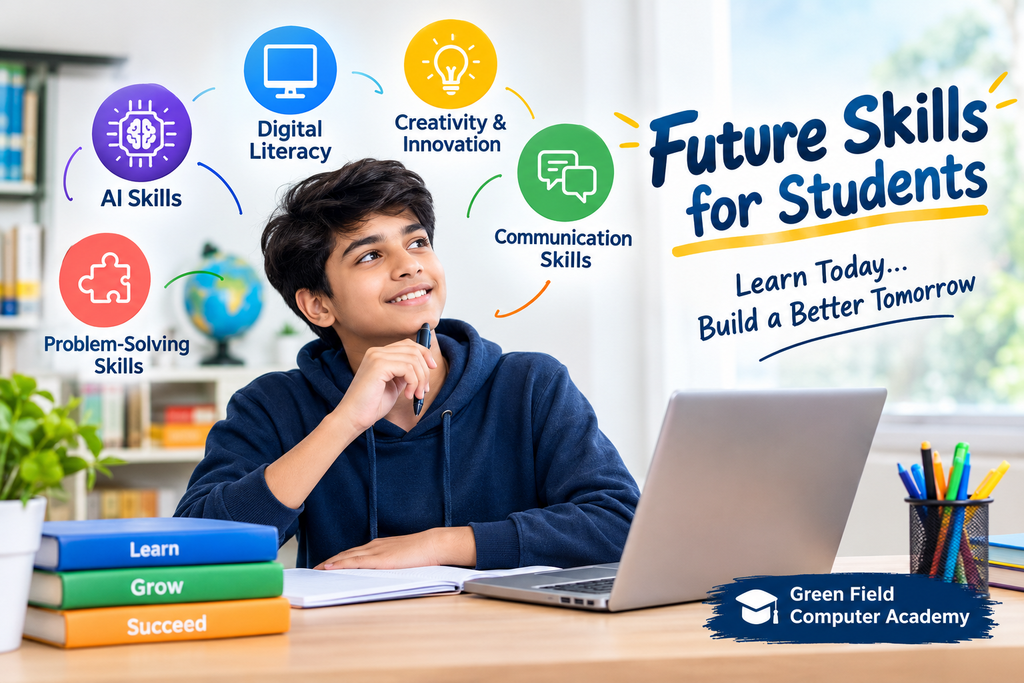
Many skills can help students in the future. However, the five skills below are the best place to start.
1. Artificial Intelligence (AI) Skills
AI is now used in education, business, healthcare and many other fields. Therefore, students should know what AI is, how it works at a basic level, and how to use it responsibly.
AI tools can explain topics, suggest ideas and give practice questions. However, AI can also make mistakes. Therefore, students should always check the answers and think for themselves.
- Ask AI to explain a topic in simple words when you feel stuck.
- Compare AI answers with trusted books and websites before you believe them.
- Use AI to get ideas for school projects, but write your own work.
- Never share personal information with AI tools, because it may not stay private.
AI literacy is one of the most useful future skills for students because it teaches them to use modern technology wisely.
2. Digital Literacy
Digital literacy means using computers, phones and the internet safely and correctly. Students use these tools for online classes, homework, research and presentations, so digital literacy makes these tasks easier.
First, students should learn typing, file management, MS Word, Excel, PowerPoint and email writing. They should also learn online safety, such as using strong passwords and spotting false information. For example, a student who knows PowerPoint can make a clear and attractive class presentation.
Digital literacy is a basic part of future skills for students because almost every school and workplace now uses digital tools.
3. Creativity and Innovation
Creativity means thinking of new ideas and finding new ways to do things. Innovation means turning those ideas into something useful. Creativity is not only about art, but it is also useful in science, maths, business and technology.
- Make posters and presentations when you get a school project.
- Write short stories or blogs, and share them with friends.
- Build a simple website after you learn basic HTML.
- Join science exhibitions and school competitions whenever you can.
Creative students explore many possible answers instead of depending on only one. This makes creativity an important part of future skills for students.
4. Communication Skills
Communication means sharing ideas clearly. It includes speaking, listening, reading and writing. Students need it for class discussions, group projects, interviews and future jobs. In fact, a student may know a lot, but explaining that knowledge clearly is just as important.
- Practise speaking in English, Hindi or any other language.
- Read books and articles, because reading improves vocabulary.
- Join debates and group discussions, as they build confidence.
- Listen carefully when others speak.
Good communication helps students work better with classmates and teachers. Hence, it is a key skill among future skills for students.
5. Problem-Solving Skills
Problem-solving means understanding a challenge and finding a good solution. Students use it when they solve maths questions, fix coding errors or complete science experiments. When something is difficult, they should break it into small steps. Here is a simple process:
- Understand the problem.
- Find the important information.
- Next, think of possible solutions.
- Then, try the best solution.
- Finally, check the result and improve it.
For example, if a computer program does not work, a student can read the error message, check the code and test a new fix. Problem-solving is one of the most valuable future skills for students because it builds logical thinking and patience.
Other Useful Future Skills for Students
Besides the five main skills, students can also learn critical thinking, basic coding, teamwork and time management. Critical thinking helps students check facts before believing them. Coding also teaches logic through tools like Scratch and Python. Similarly, teamwork helps students share work and respect different opinions. Finally, time management helps them plan study time wisely. Overall, all these future skills for students support one another.
Table: Future Skills for Students at a Glance
This table gives a quick summary of the main future skills for students, so you can see simple ways to practise them.
| Future Skill | Why It Is Important | How Students Can Learn It |
| Artificial Intelligence (AI) | Helps students understand and use modern technology wisely | Use AI tools to learn, then check the answers |
| Digital Literacy | Builds confidence with computers and the internet | Practise MS Word, Excel, PowerPoint and safe browsing |
| Creativity | Helps students create original ideas | Design posters, write stories, build simple websites |
| Communication | Improves speaking, listening and writing | Give presentations and join group discussions |
| Problem-Solving | Develops logical thinking and patience | Solve puzzles, fix coding errors, break tasks into steps |
| Critical Thinking | Helps students judge information carefully | Compare sources and check facts |
| Coding | Teaches computational thinking | Start with Scratch, Python or HTML |
How Can Students Start Learning Future Skills?
Students do not need costly equipment to begin, because small steps are enough. Follow these steps to start learning future skills for students:
- Start with the basics. Learn basic computer skills such as typing, files and the internet.
- Explore AI carefully. Use AI tools for learning, but check the answers.
- Practise with projects. Make a presentation, a webpage or a simple quiz after you learn the basics.
- Improve communication. Read, speak and explain what you learn, so your confidence grows.
- Stay consistent. Practise a little every week instead of learning everything at once.
- Take guidance. Ask teachers and trainers for help when needed.
How Green Field Computer Academy Can Help
Green Field Computer Academy helps learners build practical digital knowledge. Moreover, computer education gives school students a strong base for understanding technology. If students want to develop future skills for students, they can explore these areas at Green Field Computer Academy:
- MS Office: Prepare documents, spreadsheets and presentations, so school work becomes easier.
- Advanced Excel: Learn formulas, charts and data organisation, as these are useful in many jobs.
- Python Programming: Understand coding basics, and improve logical thinking while you practise.
- C and C++: Learn core programming concepts, because they are the base of many languages.
- Data Analytics: Explore simple ideas about data and analysis when you are ready.
The right course depends on the student’s age, level and interests. Therefore, beginners should start with basic computer skills first. Students and parents can visit https://gfca.in/ to see the available courses.
Common Mistakes to Avoid
- Depending fully on AI: AI should support learning, but it should not replace thinking.
- Learning only theory: Practical projects help students use what they learn, so do them often.
- Learning everything at once: Start with a few skills and grow step by step, because that is easier.
- Giving up after errors: Mistakes are a normal part of learning, so try again.
Frequently Asked Questions (FAQs)
1. What are future skills for students?
Future skills for students are abilities that help them learn, use technology, communicate, solve problems and prepare for a changing world.
2. Why are future skills for students important?
They make students more confident, creative and independent. They also help students use classroom knowledge in real life.
3. Which future skills for students should be learned first?
Students can begin with digital literacy, communication, creativity and problem-solving. After that, they can explore AI tools and coding.
4. Is AI an important skill for school students?
Yes, because students should know how AI tools work, where they help, and why their answers must be checked.
5. How can students improve digital literacy?
They can practise MS Word, Excel, PowerPoint, email and safe internet research. They should also learn about passwords and online safety.
6. Does every student need to learn coding?
No. Coding is useful, but communication, critical thinking and problem-solving are valuable in every career.
7. How can Green Field Computer Academy help students?
Green Field Computer Academy offers computer courses such as MS Office, Excel and programming, so students can build practical digital skills.
8. When should students start learning future skills?
Students can start while they are in school, with age-appropriate activities such as basic computer use, reading, creative projects and simple puzzles.
Conclusion
The future will bring new technology and new career options. Therefore, school students should prepare by building both technical and personal skills. The main future skills for students include AI literacy, digital literacy, creativity, communication and problem-solving.
Students do not need to learn everything in one day. Instead, they can start with computer basics, practise regularly and work on small projects. With support from teachers, parents and institutes like Green Field Computer Academy, future skills for students can become a strong base for lifelong learning.
Start learning today, practise every week, and take one step at a time towards a brighter future.