
https://www.naukri.com/advance-excel-jobs
Your Foundation for High-Paying Analytics Careers in India (Especially Delhi/NCR)
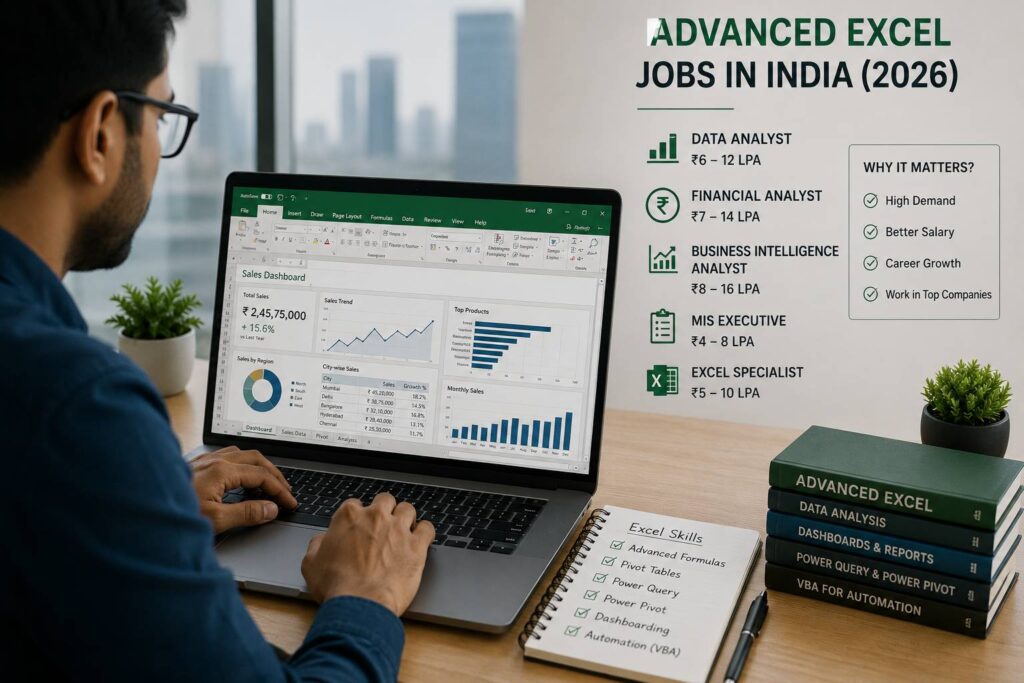
Advanced Excel is rarely listed as a standalone job title in 2026. Instead, it serves as a core skill that opens doors to roles such as MIS Executive, Reporting Analyst, Operations Analyst, Junior Data Analyst, Finance/Accounts Analyst, and entry-level Business Analyst positions.
Mastering Advanced Excel — including PivotTables, VLOOKUP/XLOOKUP, Power Query, Power Pivot, VBA macros, dashboards, and data modeling — makes you efficient at handling, cleaning, and presenting data. Companies across finance, operations, marketing, and manufacturing still rely heavily on Excel for day-to-day reporting and decision-making. However, relying on Excel alone limits your earning potential. Combining it with modern tools like SQL, Power BI (or Tableau), and basic Python shifts you into higher-paying data analyst roles.
This guide explores realistic salary expectations in India for 2026, with a special focus on Delhi/NCR, career progression paths, and practical tips to maximize your income. Salaries vary by company type (product vs service), industry, skills, and negotiation, but current market data from platforms like AmbitionBox, Glassdoor, and Naukri provides a clear picture.
Salary When You Know Only Advanced Excel (2026 Reality Check)
If your primary (or only) strong skill is Advanced Excel, you typically land in operational or reporting roles. These positions involve generating daily/weekly reports, maintaining MIS (Management Information Systems), data entry with validation, and basic analysis.
Here are typical salary ranges (LPA = Lakhs Per Annum):
- Fresher (0-1 year): MIS Executive, Data Entry with Excel, Junior Operations Executive → ₹2.5 – ₹4.5 LPA (roughly ₹20,000 – ₹35,000 per month gross). Many start around ₹3 – 3.5 LPA in smaller firms or BPOs.
- 1–3 years: MIS Analyst / Reporting Analyst → ₹4 – ₹6.5 LPA.
- 3–5 years: Senior MIS / Reporting Specialist → ₹6 – ₹9 LPA (top end in good companies).
Monthly take-home for freshers often starts at ₹18k–₹30k after deductions, depending on location and benefits. In Delhi/NCR, these roles are common in manufacturing, logistics, retail, and small finance firms. Pure Excel-heavy jobs remain mid-to-low paying because they are seen as support functions rather than core analytical ones.
Excel Expert or Advance Excel profiles on job sites show average salaries hovering around ₹3–5 LPA for early careers, with top 10% crossing ₹4.5–6 LPA only after gaining domain experience.
Why the cap? Excel-only roles involve repetitive tasks. Automation tools and BI platforms are gradually replacing manual work, so employers pay a premium for professionals who can go beyond spreadsheets.
The Real Game-Changer: Excel + Analytics Skills = Data Analyst Path
The smartest move in 2026 is to treat Advanced Excel as your foundation and layer on in-demand skills:
- SQL — for querying databases
- Power BI or Tableau — for interactive dashboards and visualizations
- Basic Python (or R) — for automation, cleaning large datasets, and simple statistical analysis
- Additional boosters: Google Data Analytics, domain knowledge (finance/marketing/operations), and a portfolio of projects
This combination transforms you from a “report generator” to a Data Analyst who derives insights, builds dashboards, and supports business decisions.
Data Analyst Salary Ranges in India (2026):
- Fresher (0-1 year): ₹3.5 – ₹6 LPA (some strong candidates with projects land ₹6–8 LPA in product companies or MNCs).
- 1–3 years: ₹6 – ₹10 LPA.
- 3–5 years: ₹10 – ₹18 LPA.
- 5+ years: ₹18 – ₹35 LPA+ (Senior Analyst / Lead roles).
Average national figures for Data Analysts sit around ₹6–7 LPA overall, with freshers often starting at ₹4–6 LPA.
Product companies (tech, e-commerce, fintech) and consulting firms (Deloitte, EY, Accenture, PwC) frequently pay 20–40% higher than service-based or traditional firms. Bonuses, ESOPs, and variable pay can add another 10–20% in good setups.
Power BI-specific impact: Professionals skilled in Power BI + Excel + SQL often see salaries jump to ₹4.5–7.5 LPA at entry level, rising quickly to ₹8–13 LPA with 2–5 years.
Delhi/NCR Salary Scenario (Your Region)
Delhi/NCR remains a strong market for analytics roles due to the presence of BFSI, consulting, IT services, government projects, and startups in Gurgaon and Noida.
- MIS/Reporting roles (Excel-heavy): Similar to national averages, but slightly higher cost of living pushes starting pay toward ₹3–4.5 LPA for freshers. Experienced MIS Analysts can reach ₹5–8 LPA.
- Data Analyst roles: Average around ₹5 – ₹13 LPA overall. Freshers in Delhi/NCR typically see ₹4–7 LPA, with Glassdoor reporting averages near ₹7.2 LPA (including mid-level). Top end for experienced analysts reaches ₹10–17 LPA in Gurgaon/Noida hubs.
Gurgaon often pays better than core Delhi due to MNC and product company presence. Factors boosting pay in NCR include proximity to corporate offices and demand in sectors like banking, telecom, and logistics.
Realistic Salary Growth Path (2026 Onwards)
Here’s a practical timeline for someone starting in Delhi/NCR:
- Year 0–1: Learn Advanced Excel deeply + complete internships or freelance reporting gigs. Target MIS Executive role → ₹20k–35k/month (₹2.5–4.5 LPA).
- Year 1–3: Add SQL + Power BI. Build 3–5 portfolio projects (sales dashboard, financial analysis, inventory tracker). Move to Junior Data Analyst / Reporting Analyst → ₹6–10 LPA.
- Year 3–5: Learn basic Python for automation + gain domain expertise. Lead small projects or mentor juniors → ₹12–18 LPA.
- Year 5+: Senior Data Analyst, Product Analyst, or BI Specialist. Focus on storytelling with data, stakeholder management, and advanced tools → ₹20–35 LPA+. In product companies or consulting, ₹25–40+ LPA is possible with strong performance.
Many professionals double their salary every 2–3 years by upskilling and switching jobs strategically. Job-hopping (with 1–2 year stints) remains common and effective in analytics.
Why Advanced Excel Is Still Extremely Valuable in 2026
Even with the rise of AI and automated BI tools, companies expect Excel proficiency as a minimum skill for most analyst and operations roles. Reasons include:
- Quick ad-hoc analysis and what-if scenarios
- Finance and accounting teams rely on it for modeling and reconciliations
- Many legacy systems export data only in Excel format
- It boosts efficiency — a skilled Excel user can save hours daily compared to someone using basic functions
When combined with other tools, Excel knowledge can increase your overall package by 20–40%. Employers value candidates who can “speak” both traditional spreadsheets and modern dashboards.
Tips to Maximize Your Salary
- Build a Portfolio: Create real-world projects (e.g., COVID sales analysis, HR attrition dashboard) and host them on GitHub or a personal site.
- Certifications: Microsoft Excel Expert, Power BI Data Analyst, Google Data Analytics Professional Certificate.
- Internships & Freelance: Start early. Even unpaid or low-paid gigs build experience and references.
- Domain Knowledge: Pair Excel/analytics with finance, marketing, supply chain, or HR understanding — this commands higher pay.
- Negotiation & Switching: Research salaries on AmbitionBox/Glassdoor before interviews. Delhi/NCR has high competition, so highlight projects and business impact.
- Soft Skills: Communication, stakeholder management, and storytelling turn good analysts into great ones (and higher earners).
- Stay Updated: Learn emerging areas like AI-assisted analytics or Copilot for Excel/Microsoft 365.
Challenges and Realistic Expectations
Excel-only careers plateau faster. Automation is reducing demand for pure manual reporting. In 2026, freshers without additional skills often compete with hundreds of applicants for ₹3 LPA roles.
On the positive side, the overall data analytics job market continues to grow. Demand for professionals who can bridge business needs with data remains strong in India.
Final Thoughts: Excel as Your Launchpad
Advanced Excel is not the destination — it’s the powerful foundation. In 2026 India (and particularly Delhi/NCR), mastering it while adding SQL, Power BI, and analytics thinking can take you from ₹3 LPA to ₹15+ LPA within 4–5 years.
Start today: Deep-dive into Excel features, build dashboards, learn one new tool every quarter, and document your work. Consistency and practical application matter more than degrees.
Whether you aim for MIS roles for stability or Data Analyst paths for growth, Advanced Excel gives you an edge that many overlook. Combine it wisely, and it becomes your ticket to a rewarding, well-paying career in India’s data-driven economy.
(Word count: ≈ 1,150)
Note: Salaries are approximate ranges based on 2025–2026 market reports and can vary. Always verify with current job postings and negotiate based on your skills and experience.
This content is ready to be copied into a Microsoft Word document (.docx). Format it with headings (H1, H2), bullet points, and tables for better readability. Add relevant images like Excel dashboards or career path infographics if desired for a professional blog look.
And to learn Advance excel you can Join Green Field Computer Academy